


Understanding Creativity
- ellenlouise
- Jan 6, 2021
- 3 min read
I decided to follow the same thought process I had with subversion, so I had a look on Wikipedia to get a broad understanding of the word 'creativity'.


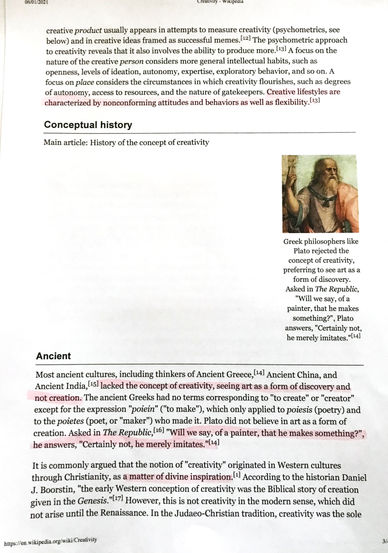





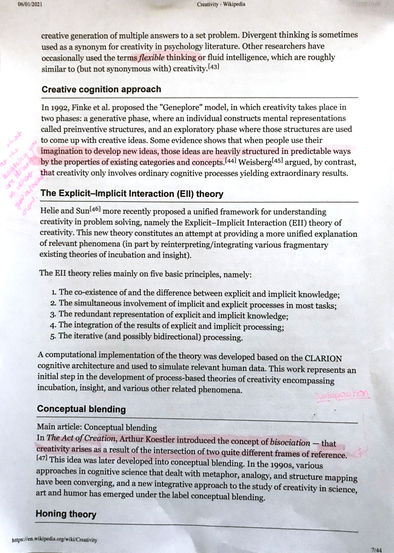


Creativity is described here as a phenomenon where something new and valuable is formed. Thought this was quite vague as a definition but it does seem relevant when I think of creativity. The word creativity comes from the Latin term 'creare' which means to create or make. It is discussed that creativity involves the production of something useful which to me suggests that there must be an outcome for something to be creative, something that has been 'made' as a result of the creativity.
I mentioned previously that creativity seems to align with innovation however it is argued in the article that this is not the case. Innovation can be creative I believe but not all creativity results in innovation as it must be implemented.
There were a few theories of creativity discussed as well. James Melvin Rhoades created this notion of "the four Ps" which are four dominant factors within in creativity. Process, product, person and place. J P Guilford discussed how creativity is linked to divergent thinking.
In history, art was seen as a discovery rather than creativity. A painter was perceived to have made something but rather had imitated it. Later creative thought was seen as divine inspiration, a message from God was received which allowed someone to create this beautiful thing before them. The first time the individual got credit, rather than God, for creating something was within the Renaissance period. This is where the ideas of creativity originated, however, it wasn't yet defined it seems.
The Wallas stage model, created by Graham Wallas, was designed to explain the creative process. The model was made up of preparation, incubation, imitation, illumination, and verification. Later some reduced this model to only four stages and saw incubation as only a subcategory. Wallas saw creativity as a result of the evolutionary process. I believe this is backed up by Yuval Noah Harari in the book Sapiens: A Brief History of Humankind. In Sapiens it is discussed that our imagination was born out of the cognitive revolution. Imagination is regularly mentioned as a key part of creativity and the creative process. Our imagination sets us apart from all the other animals in the animal kingdom. This cognitive revolution, which resulted in imagination, strengthened us as a species. I would believe in that case that every human being has the capacity to be creative in some form or another and this is not restricted to a field you work in.
The "four C" model separated creativity into different categories; mini-c, little-c, Pro-C and Big-C. Pro-C is exhibited by people who are professionally creative so I believe this is the category that Graphic Designers, and many other creative practitioners, would fall into.


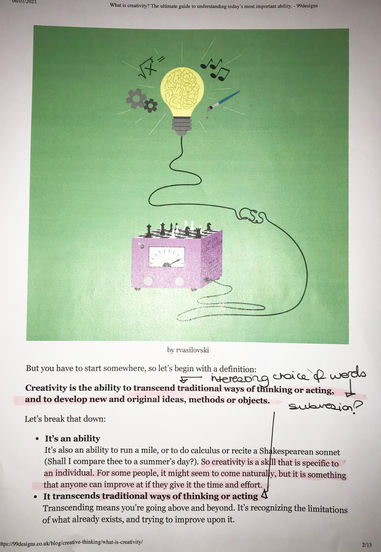





In a blog post regarding creativity, linked above, I noticed an interesting combination of words.
"Creativity is the ability to transcend traditional ways of thinking or acting, and to develop new and original ideas, methods or objects."
Sounds quite subversive to me... Could it be considered to be subversive to use your brain in a non-traditional way? Later in the post, it discusses the link between psychology and creativity. There are 3 networks in your brain; the executive attention network, the imagination network and the salience network. It suggests that if you utilised all these networks so they work together you become more creative.
Bibliography.
Creativity (2020). In Wikipedia. Retrieved January 6, 2021 from https://en.wikipedia.org/wiki/Creativity
Morr, K. (2018) What is creativity? The ultimate guide to understanding today’s most important ability. 99 Designs. https://99designs.co.uk/blog/creative-thinking/what-is-creativity/


Comments